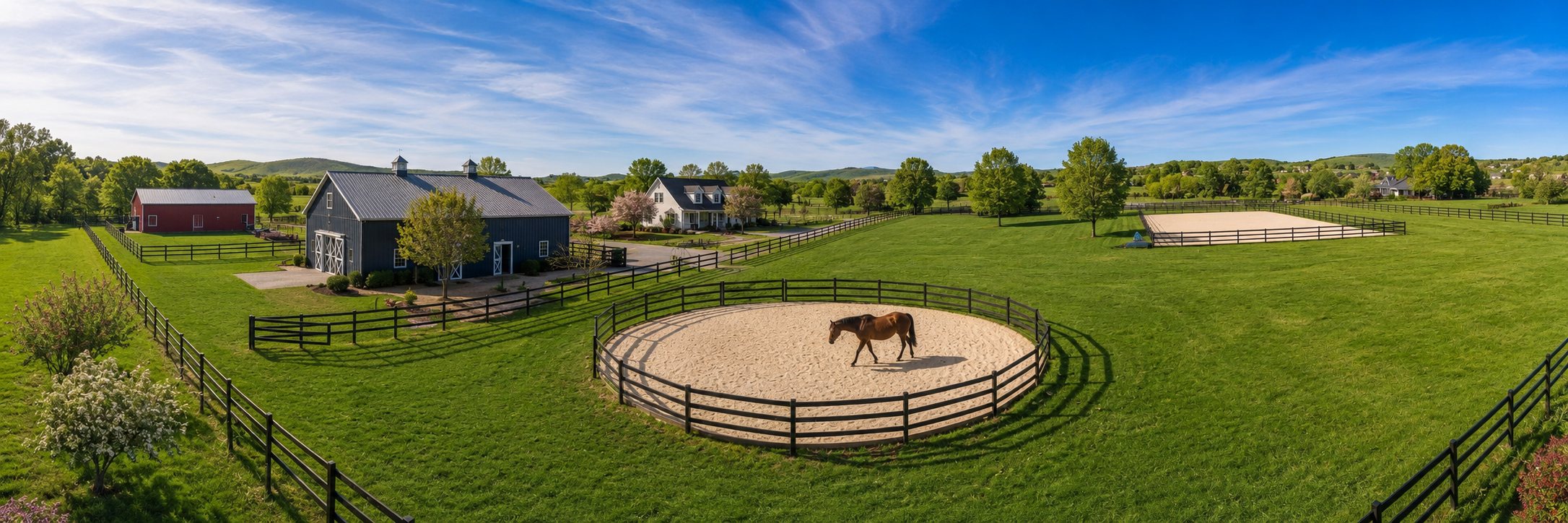
Every horse owner has a fence story. A gelding who leaned on a board until it gave. A mare who caught a shoe on a loose wire. A colt who spooked at a plastic bag and went straight through a rail.
Horses are big, fast, curious, and wired to run first and think later. A fence that holds up fine for cattle or a backyard dog can turn dangerous with a 1,200-pound flight animal on the other side of it.
So the question is not just whether a fence keeps horses in. It is what the fence does to a horse on its worst day. Below we cover what makes a fence safe for horses, how the common options compare, and where each one fits.
What Makes a Fence Safe for Horses
Six things separate a horse-safe fence from a fence that just marks a line.
1. Horses can see it
Horses are far-sighted and spook easily. A fence they can read from across the pasture is a fence they are far less likely to run into. Wide rails and boards are easy to see. Thin wire is not, especially at dusk.
2. Nothing sticks out
Nails back out of wood. Screws loosen. Wire ends fray. Every protruding piece of hardware is something a halter, hoof, or hide can catch on. The safest fence has nothing on its surface to catch at all.
3. The gaps are the right size
Openings between rails need to be small enough that a horse cannot easily put a head or leg through and get caught. Tight spacing matters most where horses spend time close to the fence: paddocks, runs, alleys, and round pens.
4. The height and bottom clearance fit the herd
Penn State Extension recommends horse fences stand 54 to 60 inches tall, with a bottom rail no higher than about 12 inches so foals cannot roll under. A bottom rail set much higher than that also invites horses to reach under for grass.
5. It holds up to everyday pressure
Horses lean, rub, scratch, and push, especially along shared fence lines and at gates. A safe fence takes that pressure every day without sagging, loosening, or slowly working its way apart.
6. It fails safely
This is the one most people skip. Even the calmest horse can spook and hit a fence at speed. In that moment, the fence either breaks, holds rigid, or gives way. The difference between those three outcomes can be the difference between a scare and a vet emergency.
How Common Horse Fences Compare
| Fence Type | Visibility | Hardware and Edges | On a Hard Impact | Upkeep |
|---|---|---|---|---|
| Kuptz steel rail | High | No nails, screws, or fasteners | Rail releases in one piece | Minimal |
| Wood board | High | Nails and screws that work loose | Board can snap and splinter | High |
| Vinyl rail | High | Mostly smooth | Rail can crack or shatter | Moderate |
| Pipe | Moderate | Welds, caps, and cable | Very rigid, little give | Moderate |
| Smooth or high-tensile wire | Low | Thin strands | Risk of cuts and entanglement | Moderate |
| Electric tape | Moderate | Thin tape and insulators | Little physical barrier | High |
| Barbed wire | Low | Barbs by design | Severe lacerations | Moderate |
Wood Board: Classic Look, Real Risks
Wood board fence has been on horse farms for generations, and it is easy to see why. It looks right, horses see it well, and a broken board is easy to swap out.
The trouble is what happens before you swap it out. Wood rots, warps, and gets chewed. Nails work loose and back out. And a hard enough hit snaps a board, leaving a splintered, jagged end at chest height. Those injuries can be devastating.
Wood can be a reasonable choice for low-pressure areas where you are prepared to walk the line, replace boards, and repaint on a regular schedule. It is a harder sell anywhere horses crowd the fence.
Vinyl: Low Maintenance Until It Cracks
Vinyl rail looks clean, does not rot, and does not need paint. For a lot of homeowners it is a good fit.
Horses are a different test. Vinyl can turn brittle in cold weather and soften in heat. On a hard impact a vinyl rail can crack or shatter, and a cracked rail leaves sharp edges just like a broken board. A rail that pops out whole is fine. One that breaks is not.
Pipe: Strong, but Rigid
Pipe fence is extremely strong, which is why it shows up in arenas, pens, and working facilities. It is also very rigid. A pipe rail hit at speed does not move, so the horse absorbs the force.
Look closely at the details on a pipe fence too. Welds, open pipe ends, and caps can wear or break over time. Pipe fences that use cable between posts add entanglement risk. A well-built pipe fence with smooth joints and capped posts is a different animal from a patched-together one.
Wire and Electric: Cheap to Build, Hard to See
Smooth wire and high-tensile wire are popular for big acreage because they cost little per foot. The tradeoff is visibility. Thin strands are hard for a horse to see, and a horse that runs into wire can be cut or tangled.
Electric tape is easier to see and easy to move, which makes it useful for temporary paddocks and rotational grazing. It works by teaching horses to respect it, not by holding them. A panicked horse can go right through it, and it stops working the moment the power does.
Barbed Wire: Never for Horses
Barbed wire was built for cattle. Horses panic when caught, and a horse fighting barbed wire can suffer severe, sometimes career-ending, lacerations. There is no horse setup where barbed wire is the safe choice.
Steel Rail: Built Around How Horses Behave
A Kuptz fence is designed around the six points above.
- Nothing to catch on. Rails slide into the posts and a single rail lock holds them. There are no nails, screws, or fasteners anywhere on the fence.
- Smooth, rounded edges. Every rail opening in every post is lined with a rubber grommet, so there is no raw steel edge where the rail passes through.
- Easy to see. Wide rails in texture black or gloss white read clearly from across a pasture.
- Tight spacing where it counts. 4-rail leaves 7¼" between rails. The bottom rail sits 12" off the ground on both 3-rail and 4-rail. Every configuration stands 57" tall, right in the middle of the recommended range.
- Strength without add-ons. Kuptz rails are wider and shorter than other steel fence rails, rated to 700 lbs with no reinforcement inserts.
- It lets go instead of breaking. The rails hold firm through everyday leaning and rubbing. Only a full stampede into the fence pops a rail out of the post, and it comes out in one piece. It does not shatter, and it is not sharp.
Steel also does not rot, splinter, or need paint, so the fence you install is the same fence a few years later. The comparison page has the full side-by-side against other steel fences.
Gates Matter as Much as the Fence
Gates take more abuse than any other part of a fence line. Horses gather there, push there, and wait there. Penn State Extension recommends gates as tall and as strong as the fence itself, without diagonal bracing that can trap a leg.
Kuptz gates come in 4' and 10' widths, in 3-rail and 4-rail to match the fence. They hang on end posts with standard hardware. See the specs on the dimensions page.
Layout Is Part of Safety
Even the best fence can be laid out badly. A few rules of thumb:
- Avoid tight corners and dead ends in shared turnout, where a dominant horse can pin another one.
- Use tighter spacing where horses are close together. Most horse properties run 4-rail around paddocks, runs, and round pens, then 3-rail on the long pasture lines. Our guide to 3-rail vs. 4-rail walks through the tradeoff.
- Put gates where horses can move through them easily, not tucked into a corner.
Frequently Asked Questions
What is the safest fence for horses?
A safe horse fence is highly visible, has nothing sticking out to catch on, uses tight rail spacing where horses gather, and does not break into sharp pieces on impact. Smooth steel rail fencing with no fasteners checks all of those boxes. Barbed wire is never safe for horses.
Is steel fencing safe for horses?
Yes, when it is designed for horses. Kuptz steel fence has no nails, screws, or fasteners, smooth rounded edges, and rubber-lined rail openings. On a full stampede impact a rail pops out of the post in one piece instead of breaking, so there are no jagged ends.
Is wood or vinyl fencing safe for horses?
Both are common, and both carry risks. Wood boards can snap and splinter on impact, and nails work loose over time. Vinyl rails can crack or shatter on impact, especially in cold weather. Either one leaves sharp edges when it breaks.
How far off the ground should the bottom rail be?
Penn State Extension recommends a bottom rail no higher than about 12 inches so foals cannot roll under. Kuptz 3-rail and 4-rail both sit 12" off the ground.
What color fence is best for horses?
Choose the color that stands out most against your property. Kuptz comes in texture black and gloss white, and both work well on horse properties. Wide rails in either color are far easier for a horse to see than wire.
Is barbed wire ever okay for horses?
No. Barbed wire was built for cattle. A horse that gets caught tends to panic and fight it, which can cause severe lacerations.
Plan a Safer Fence for Your Horses
The fastest way to see what a safe fence looks like on your property is to draw it. Open the Kuptz Drawing Tool, lay out your paddocks, pastures, and gates on a satellite view, and see your estimated cost in minutes. Our team will follow up with recommendations for your horses.
Prefer to talk it through? Call 720.970.2599. For more on how Kuptz is built for horses, visit our equestrian page.