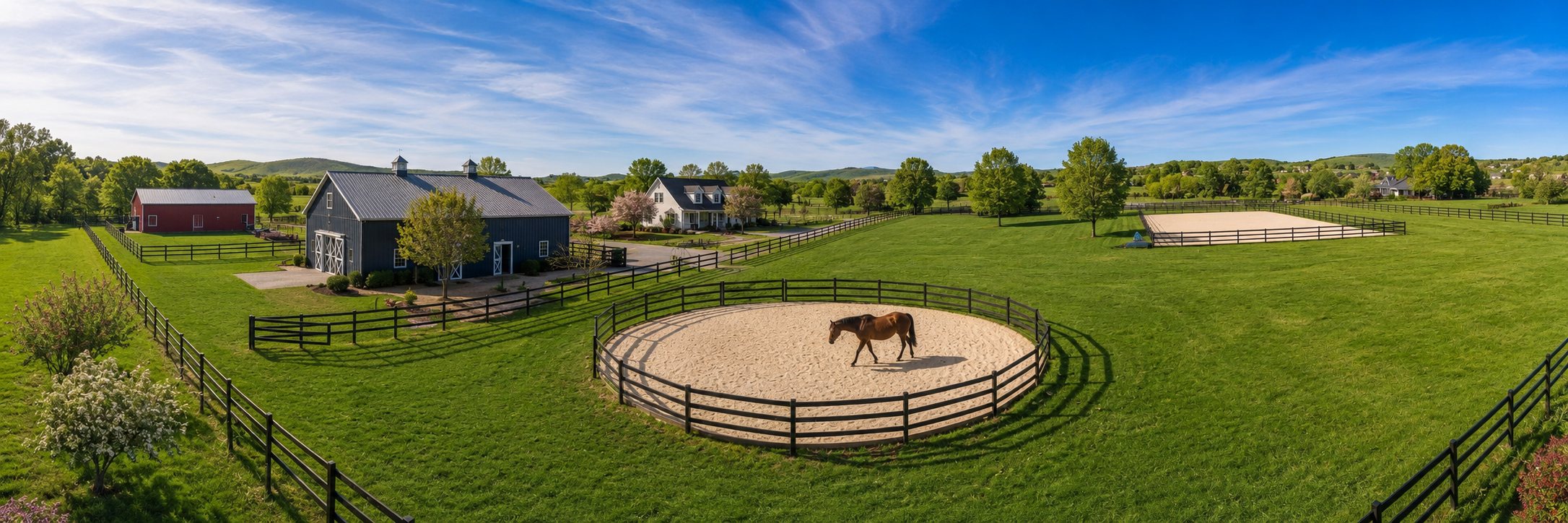
A pasture fence and a paddock fence do different jobs. Out on open pasture, horses have room to move and spend most of their time well away from the fence line. In a paddock, the fence is never more than a few strides away.
That changes everything about what the fence needs to handle. Below we cover why paddocks are harder on fencing, what a good paddock fence looks like, and how to lay out paddocks that keep horses safe.
Why Paddocks Are Harder on a Fence
Put horses in a smaller space and the fence takes more contact, more often.
- Horses crowd the fence line. They gather where they can see the barn, the gate, or the horses next door.
- They lean and reach. The grass on the other side is always better, so horses stretch over and through the rails.
- They squabble. Sorting out the pecking order in a tight space can push a horse into the fence.
- They spook with nowhere to go. A startled horse in a small paddock hits the fence much sooner than one in a 10-acre field.
- Boredom leads to chewing. Horses with less to graze often turn on the fence itself, and wood boards get the worst of it.
A fence that works fine on the back pasture can wear out fast, or hurt a horse, once it is wrapped around a small turnout.
What a Good Paddock Fence Needs
Tight rail spacing
Gaps should be small enough that a horse cannot easily get a leg or head through and get caught. Kuptz 4-rail leaves 7¼" between rails, the tightest spacing we offer and our recommendation for paddocks, runs, alleys, and round pens.
A low bottom rail
Penn State Extension recommends a bottom rail no higher than about 12 inches to keep foals from rolling under. Kuptz 4-rail and 3-rail both sit 12" off the ground.
The right height
The same guidance puts horse fence height at 54 to 60 inches. Every Kuptz fence stands 57" tall with the top rail at 54".
Nothing to catch or cut
In a paddock, horses touch the fence every day. Kuptz has no nails, screws, or fasteners, and every rail opening is lined with a rubber grommet. There is nothing sticking out to catch a halter, blanket, or hoof.
Strength without add-ons
Constant leaning loosens weak fences. Kuptz rails are wider and shorter than other steel fence rails, rated to 700 lbs, and never need reinforcement inserts.
A safe failure
A hard hit should never leave a rail broken into sharp pieces. Kuptz rails hold firm through everyday pressure, and only a true stampede into the fence pops a rail from the post, in one piece.
How Paddock Fence Materials Compare
| Material | In a Paddock | Main Concern |
|---|---|---|
| Wood board | Visible, traditional look | Chewing, loose nails, broken boards |
| Vinyl rail | Clean look, no paint | Cracks under impact and cold |
| Wire | Inexpensive | Low visibility, cuts, entanglement |
| Electric tape | Easy to move | Not a physical barrier |
| Pipe | Very strong | Rigid on impact, welds and caps |
| Kuptz 4-rail steel | Tight 7¼" spacing, no fasteners | Higher upfront cost than wood or wire |
Wood remains the most common paddock fence, and it is also the one that takes the most abuse in a paddock. Bored horses chew it, leaning horses loosen it, and a horse that hits it hard can snap a board. For a closer look at how each option handles a hard impact, see our guide to safe fencing for horses.
Laying Out Your Paddocks
Share fence lines
A row or grid of paddocks uses less fence than separate pens, because one line serves two paddocks. Kuptz tee posts split one line into two, so grids, shared lines, and alleys lay out cleanly.
Avoid tight corners and dead ends
In shared turnout, a sharp corner or narrow dead end is where a dominant horse can trap a subordinate one. Keep paddocks open and give horses room to move away from each other.
Plan your alleys
An alley between paddocks lets you move horses to and from the barn without leading them through other turnouts. It also keeps horses in neighboring paddocks from touching noses over a single shared line.
Put gates where you actually walk
Place walk gates on the path you use every day, not tucked into a corner where horses bunch up. Add at least one wide gate for a tractor, manure spreader, or trailer. Kuptz gates come in 4' and 10' widths, match your rail count, and hang on end posts with standard hardware.
Pick high, well-drained ground
Paddocks take heavy traffic, and low ground turns to mud fast. Site them on the highest, best-drained spot near the barn when you can.
Work with your terrain
Kuptz rails angle up, down, left, or right by 22.5° where they meet the post, so paddock lines can follow a slope or curve without custom parts.
What a Paddock Grid Costs
Take a row of three 60' x 100' paddocks. The outside measures 180' x 100', or 560 feet, plus two 100' dividers between them.
- Fence: 760 feet of 4-rail at $26 per foot = $19,760
- Gates: three 4' 4-rail walk gates at $700 = $2,100
Estimated materials total: $21,860, before shipping, taxes, and installation. Current prices are on the pricing page, and our guide to horse fencing cost prices out a full 5-acre property.
Paddocks in 4-Rail, Pasture in 3-Rail
Most horse properties do not need one fence everywhere. The common setup is 4-rail around paddocks, runs, and anything near the barn, then 3-rail on the long pasture lines where horses have room to move. Both stand 57" on 8' post centers and share the same posts, finish, and gates, so the two sections meet cleanly.
That puts the tighter, stronger fence where horses actually pressure it and keeps the long runs economical. Our 3-rail vs. 4-rail guide covers the tradeoff in detail.
Frequently Asked Questions
What is the best fence for a horse paddock?
A paddock fence needs tight rail spacing, a bottom rail about 12 inches off the ground, a height of 54 to 60 inches, and nothing that can catch or cut. We recommend Kuptz 4-rail for paddocks, with 7¼" between rails and no nails, screws, or fasteners.
Can I use 3-rail fence for a paddock?
3-rail works well for larger turnouts and open pasture where horses have room to move. For small paddocks, runs, and alleys where horses are close to the fence, we recommend 4-rail.
How wide should a paddock gate be?
Most properties use a 4' walk gate for leading horses and at least one 10' gate for a tractor, trailer, or manure spreader. Kuptz offers both in 3-rail and 4-rail.
Where should paddock gates go?
On the path you use every day, away from corners where horses bunch up. A gate at the end of an alley makes moving horses to and from the barn easier.
How do I stop horses from chewing the paddock fence?
Horses chew wood, especially when bored in a small space. Steel rails give them nothing to splinter, and more turnout time and forage help with the boredom behind the habit.
Lay Out Your Paddocks
Paddock layouts are easier to judge when you can see them on your own land. Open the Kuptz Drawing Tool, sketch your paddocks, alleys, and gates on a satellite view, and see your estimated cost in minutes. Our team will follow up with recommendations.
Want help deciding what goes where? Call 720.970.2599. You can also see how Kuptz is built for horses on our equestrian page.